


Commercial Door Handing Guide
Understanding and correctly identifying door handing is essential when ordering commercial doors, frames, and hardware. Whether you’re planning for a simple single door or a complex double opening, the handing determines how the door swings and where the hinges are located—affecting everything from the frame prep to panic hardware and code compliance.
Door handing refers to the direction a door swings and which side the hinges are on when viewed from a specific reference point. In commercial construction, handing is always determined from the push side of the door (the side where you push the door to open it).
Handing for Single Doors
To determine handing for a single door, stand on the push side (side without visible hinges) and observe the hinge location and swing direction:
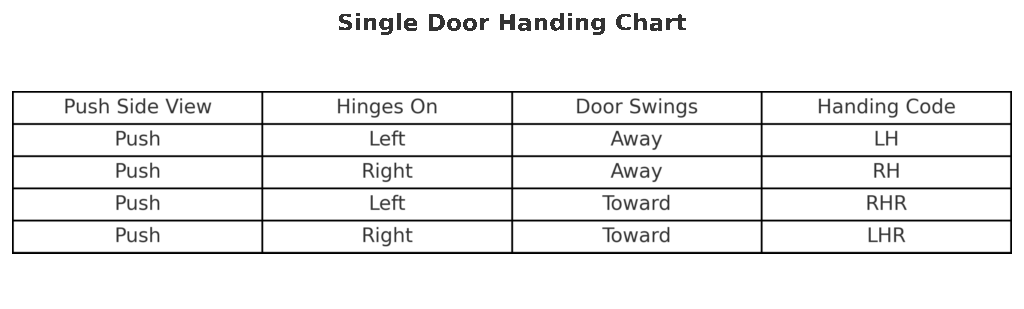
Key Definitions:
-
LH (Left Hand): Push to open away from you, hinges on the left.
-
RH (Right Hand): Push to open away from you, hinges on the right.
-
LHR (Left Hand Reverse): Pull to open toward you, hinges on the right.
-
RHR (Right Hand Reverse): Pull to open toward you, hinges on the left.
Handing for Double Doors
Double doors are common in commercial and institutional buildings and require careful handing identification depending on their swing configuration and hardware prep.
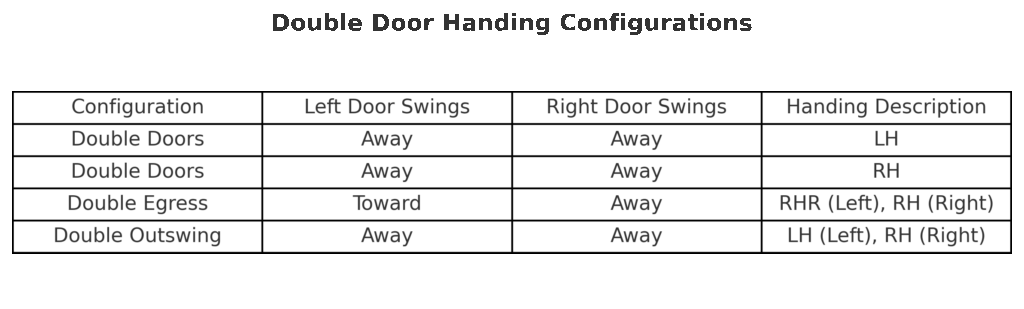
1. Double Doors (Same Direction Swing)
Used when both doors swing in the same direction (in or out) with one door active and the other inactive.
-
The inactive leaf is often fitted with flush bolts or surface bolts.
-
Each leaf is handed individually based on its own push side and hinge location.
2. Double Egress Doors
Used in corridors where traffic flows in opposite directions—common in schools, healthcare, and egress paths.
| Configuration | Left Door Swings | Right Door Swings | Description |
|---|---|---|---|
| Double Egress | Toward you | Away from you | RHR (left), RH (right) |
-
Both leaves swing away from each other
-
Typically used with vertical rod exit devices
-
No mullion between doors
3. Double Outswing Doors
Used in egress applications where both doors swing outward from the opening toward the exterior or hallway.
| Configuration | Left Door | Right Door | Description |
|---|---|---|---|
| Double Outswing | LH | RH | Both leaves swing away from the room |
-
Common in fire exits and exterior emergency doors
-
Usually requires panic hardware or exit devices
-
Often symmetrical for visibility and safety
Tips for Accurate Handing
-
Always stand on the push side of the door when determining handing.
-
Double-check whether you’re referencing handing for the door, frame, or hardware—terminology can differ.
-
For reverse swing doors, remember you’re on the push side, but the door opens toward you.
-
Confirm egress direction with local building codes—handing may be code-dictated in rated corridors, stairwells, and exits.